
If you take a quick look at the modern vaping industry, it is entirely dominated by sleek, highly portable, pocket-friendly pod systems. Everything is designed to be as stealthy and unobtrusive as possible. We live in the era of high-strength nicotine salts and discrete, invisible vapor clouds.
But it wasn’t always this way.
If you rewind the clock a few years, the vaping scene was locked in a ridiculous, unapologetic “horsepower war.” Manufacturers were constantly trying to outdo each other, building larger, heavier, and substantially more insane box mods designed strictly to pump out the maximum amount of vapor physically possible. The culmination of that arms race resulted in devices that looked less like electronic cigarettes and more like military hardware.
Enter the iJoy MAXO 315W.
This device is not for the faint of heart. It is a massive, incredibly heavy, four-battery behemoth that firmly tells your modern 2-battery setups to step aside and hold its beer. Based on a nostalgic deep-dive and rigorous hardware test by Russian vape critic Vape Дед, we are looking back at this absolute monster to see how it holds up today, what it takes to actually vape at 315 watts, and why this aggressively old-school device still holds a very special place in the hearts of hardcore enthusiasts.
The Aesthetics of a Brick
When you first pull the iJoy MAXO out of its matte black packaging, the sheer physical presence of the device is genuinely shocking. This is not something you are going to casually slip into the front pocket of your skinny jeans.
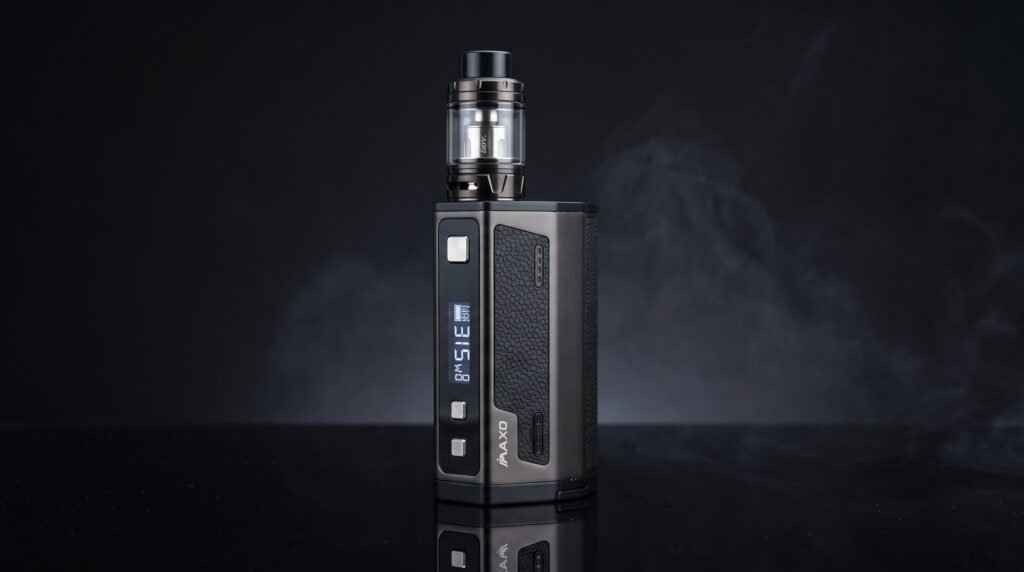
Despite its intimidating size, the ergonomics are surprisingly well-thought-out. iJoy avoided sharp, aggressive corners, opting instead for heavily rounded, sloping edges that allow the massive chassis to fit somewhat comfortably in a large hand. The standard finish is a deeply understated, matte black metal. There are no flashy RGB LED strips, no neon resin panels, and no glossy fingerprints. It looks strictly utilitarian.
However, iJoy did include a bit of old-school customization in the box. Along with the device, you get a handful of die-cut sticker panels (including faux leather and carbon fiber textures). You can peel and stick these directly onto the recessed side panels of the mod to give it a custom two-tone look.
The build quality is incredibly rugged. The top plate features a heavy-duty, unpainted stainless steel 510 connector with a spring-loaded pin, capable of accommodating massive 25mm (and larger) sub-ohm tanks without any annoying overhang. The bottom battery door is a hinged, mechanical latch system that feels solid, though the front interface buttons (the fire button and the wattage toggles) do have a slight, audible rattle when you shake the device. It is a minor machining flaw, but one that was entirely common for mass-market devices built during this era.
Under the Hood: 4 Batteries and a Micro-USB Port
To power a device capable of hitting 315 watts, you need serious electrical overhead. The bottom mechanical latch springs open to reveal a massive battery bay designed to hold four separate 18650 batteries.
Looking down into the battery sled feels like looking into the loaded chambers of a quad-barrel rocket launcher. Because the batteries run in two sequential series pairs, it is absolutely critical that you “marry” your batteries—meaning you use four identical 18650s of the same brand, same capacity, and same age to ensure they discharge safely and evenly.
On the side of the device, you will notice a micro-USB port. While the chipset theoretically allows you to charge the batteries internally, you should absolutely never use this port for charging. Attempting to balance-charge four separate 18650 cells through a fragile micro-USB connection is a recipe for disaster and incredibly slow charging times. You will absolutely need to invest in a dedicated, 4-bay external battery charger to run this mod safely.
The interface itself is a blast from the past. You get a simple, vertically oriented monochrome display screen. Five clicks of the firing button turn the device on, revealing a highly legible readout showing your wattage, coil resistance, puff counter, and a dual-battery icon representing the two battery pairs. Three clicks drop you into the menu, where you can swap between Temperature Control modes (Nickel, Titanium, Stainless Steel), or adjust the power pre-heat curves (Normal, Hard, Soft, and a custom User curve).
Firing the Rocket Launcher: Real-World Performance
You don’t buy a 315-watt device to put a tiny 15-watt tank on it. To properly benchmark the MAXO, the reviewer paired it with a massive, era-accurate sub-ohm tank housing an absurd 6-coil internal atomizer reading at 0.12 ohms.
When you are dealing with a coil housing six separate heating wires, you need raw, unadulterated power just to get the metal to heat up.
-
At 90 Watts: The tank barely even wakes up. It produces a weak, airy wisp of vapor.
-
At 110 Watts: The vapor production starts to normalize, but it still feels underpowered for the size of the coil.
-
At 150 to 170 Watts: This is where the iJoy MAXO completely takes off. The ramp-up time is virtually instantaneous. The device acts like a literal fog machine, forcefully pushing out incredibly dense, hot, flavor-saturated clouds that can completely blind out a room in two or three exhales.
Vaping at 170 watts on a 70/30 VG/PG freebase e-liquid is an entirely different sport than puffing on a modern pod system. The flavor is overwhelmingly thick, the vapor density is aggressive, and the physical act of inhaling feels heavy. You also have to aggressively monitor your juice levels; running a 6-coil setup at this wattage will literally drain a 5ml tank dry in a matter of minutes.
The “Infinite Battery” Hack
While cloud-chasing is the primary draw, the iJoy MAXO hides a hilarious secondary use-case.
Because it holds four 18650 batteries, the total milliamp-hour (mAh) capacity is absolutely astronomical—easily exceeding 10,000mAh depending on the batteries you install. If you decide to ignore the 315-watt ceiling and instead thread a modern, highly restrictive MTL (Mouth-to-Lung) tank onto the 510 connector, the results are incredible.
If you vape a 1.0-ohm coil at roughly 15 to 20 watts using a 4-battery mod, the power draw is so laughably small that you practically forget what a battery charger looks like. You can easily go three, four, or even five full weeks of daily vaping before the battery indicator drops to zero. It transforms this aggressive cloud-chucking machine into the ultimate survivalist, off-the-grid desktop vape.
Pricing and The Final Verdict
When the iJoy MAXO 315W originally launched to the global market, it retailed right around the $50.00 to $65.00 USD mark. Considering the fact that it houses a 300+ watt proprietary chipset and holds four batteries, it was actually positioned as a highly accessible, budget-friendly flagship.
Is it practical in 2026? Absolutely not. It is far too heavy to comfortably carry in a pocket, it drinks e-liquid like a V8 engine drinks gasoline, and requiring four married 18650 batteries is an expensive hurdle for newer vapers. (As the reviewer joked, the mod is so heavy you could legitimately use it to defend yourself in a dark alley).
But practicality isn’t the point. The iJoy MAXO 315W is a love letter to the era of extreme vaping. It is for the hobbyist who sits at their desk at home, wants to blow an obscenely massive cloud just for the fun of it, and wants to experience raw, unfiltered power. It is a rugged, beautifully simple steam machine that proves sometimes, more really is just more.